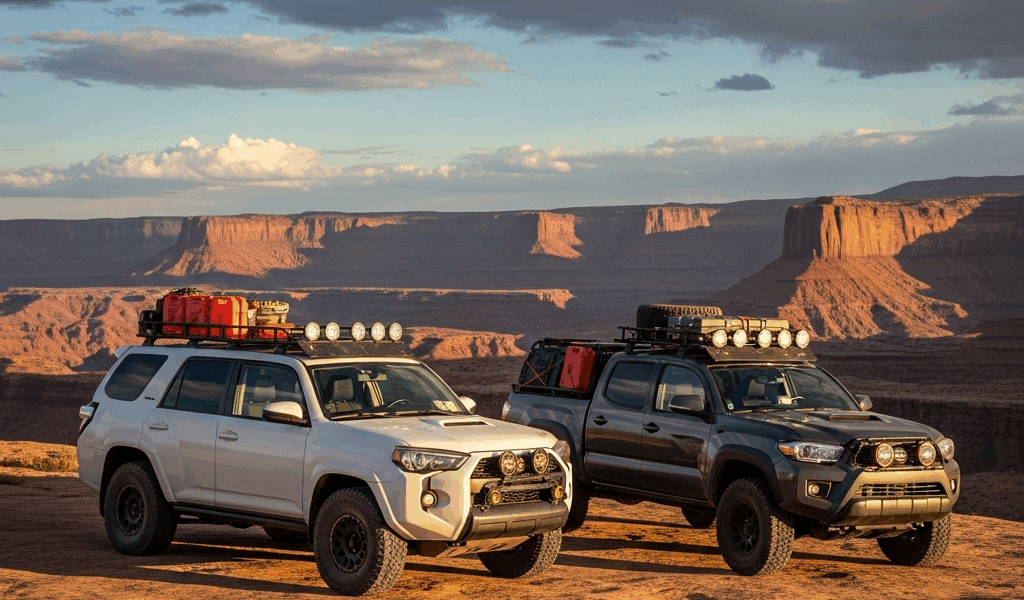
4Runner vs Tacoma for Overlanding — Which One After 2026
The 4Runner vs Tacoma overlanding debate has gotten complicated with all the outdated comparisons flying around. Most articles you’ll find are still arguing about the old V6 generations like it’s 2019. That debate is dead. For 2025 and 2026, both trucks share the same TNGA-F platform and both run Toyota’s 2.4L turbocharged i-FORCE MAX engine family. That single fact dismantles almost every argument people have been recycling for years. I’ve spent the last several months building out a Tacoma TRD Off-Road for a two-person desert and mountain setup, and the platform convergence forced me to rethink assumptions I’d carried forever. This is the comparison I wish had existed before I started buying parts.
Same Platform, Different Missions — What Changed for 2025-2026
Most overlanders shrugged when Toyota confirmed the platform announcement. Platform sharing sounds like a fleet management decision — not something that changes a build. It matters more than that.
The TNGA-F is a body-on-frame architecture Toyota engineered with global truck markets in mind. The fifth-generation 4Runner and the third-generation Tacoma both ride on it. Suspension geometry, frame rail spacing, transfer case mounting points — closely related across both vehicles. That means parts compatibility will expand over time, which is genuinely useful when you’re sourcing aftermarket skid plates or crossmembers three years from now in a small town in Sonora.
But what is the engine distinction here? In essence, it’s this: the 2025-2026 4Runner comes standard with the turbocharged 2.4L i-FORCE producing 278 horsepower and 317 lb-ft of torque. The base Tacoma uses the non-hybrid version of that same block — 228 horsepower, 243 lb-ft. The Tacoma i-FORCE MAX hybrid bumps that to 326 horsepower and 465 lb-ft. But it’s much more than a spec sheet difference.
For overlanding, torque at low RPM is what actually moves a loaded vehicle through deep sand or up a loose shale slope. The base Tacoma’s 243 lb-ft is adequate. The 4Runner’s 317 lb-ft is better. The MAX hybrid’s 465 lb-ft is overkill in the best possible way — except you’re adding roughly $6,000 to the purchase price and introducing a hybrid system into an environment that includes water crossings, heavy vibration, and remote locations without a dealer in sight.
I’m apparently someone who values simplicity over peak torque numbers, and the standard 4Runner powerplant works for me while the MAX never quite made sense for trips two hundred miles from pavement. The base Tacoma is fine. Don’t make my mistake of obsessing over the MAX specs before doing the math on where you’ll actually be driving.
Payload and Cargo — the Real Overlanding Constraint
Probably should have opened with this section, honestly. Payload capacity kills more overland build dreams than any other single number — and people consistently ignore it until they’ve already bought the roof tent.
So, without further ado, let’s dive into actual numbers. A realistic two-person overland kit looks something like this:
- Rooftop tent (iKamper Skycamp 2.0) — 154 lbs
- Roof rack or bed rack (Prinsu full bed, steel) — 87 lbs
- Fridge (BougeRV 40Qt compressor) — 44 lbs
- Water (two 7-gallon Scepter jugs, full) — 117 lbs
- Recovery gear, tools, and camping kit — 210 lbs
- Two adults, average — 380 lbs
That’s 992 lbs before food, fuel cans, camera gear, or a dog. The 2025 Tacoma TRD Off-Road lists payload at 1,440 lbs. The 2025 4Runner TRD Off-Road comes in at 1,500 lbs. Close. But where that weight sits on the vehicle changes everything about how each one handles it — and no single number on the window sticker tells you that story.
The 4Runner’s enclosed cargo area holds roughly 89 cubic feet with seats down. Fridge, recovery gear, tools — heavy items stay low and between the axles. Optimal weight distribution on paper. In practice, you’re also adding a roof rack and RTT to a vehicle that already sits taller than the Tacoma. That’s where center of gravity problems enter the picture.
The Tacoma puts heavy gear in the bed. The bed floor sits lower than the 4Runner’s roof. That geometric reality shapes everything about how these two vehicles behave on off-camber terrain with a full load. That’s what makes this comparison endearing to us overlanders — it’s never just one number.
Rooftop Tent Mounting — Bed Rack vs Roof Rack
The bed rack versus roof rack question is where the 4Runner vs Tacoma decision gets tactile. This is what you’ll actually feel on every mountain switchback.
Roof Rack on the 4Runner
A loaded roof rack on any SUV raises the center of gravity substantially. The iKamper Skycamp 2.0 at 154 lbs, sitting on a Prinsu 4Runner full roof rack at 72 lbs, puts 226 lbs roughly 78 inches above the ground. The 2025 4Runner already has a roof height of 70.1 inches. That weight is living at the very top of the vehicle.
On flat forest roads and mild rocky trails, you’ll never notice. On a loose side-hill carrying water and recovery gear, you notice. The factory ARB Old Man Emu suspension upgrade — OME BP-51 kit, around $2,800 installed — helps manage body roll, but it doesn’t relocate where the mass is. Physics doesn’t negotiate.
Roof rack weight limits are the other constraint. The Prinsu 4Runner rack is rated for 300 lbs dynamic load. Tent plus rack already sits at 226 lbs, leaving 74 lbs of headroom for anything else. Some people run solar panels up there too. That math gets tight fast.
Bed Rack on the Tacoma
Frustrated by high center-of-gravity compromises, most serious Tacoma builders gravitate toward a bed rack setup using the 5-foot bed — placing that same RTT at roughly 54 inches off the ground, measurably lower than the roof mount on the 4Runner. The Go Rhino XRS Overland Bed Rack in steel runs $649 and is rated for 500 lbs static, 250 lbs dynamic. That’s real headroom.
The tradeoff is bed space. With the tent mounted on a full bed rack, cargo room shrinks considerably. You can run a mid-height rack that leaves space under the tent platform for gear bins — but you’re managing a three-dimensional puzzle every time you pack. I use a Decked drawer system under my rack, two drawers each rated at 200 lbs, and it’s solved most of the organization problem. The Decked system for the third-gen Tacoma runs about $1,450. Worth every dollar.
The handling difference between a bed-mounted tent and a roof-mounted tent is real and noticeable. Not dangerous on either vehicle when driven sensibly. The Tacoma with a bed rack is more confidence-inspiring on off-camber terrain — at least if you’re the kind of driver who pays attention to what the steering is telling you. That’s not a spec sheet claim. That’s what it feels like at the wheel.
Electrical System for 12V Accessories
A modern overland rig needs at least two things electrical: a way to run a compressor fridge without killing the starter battery, and a way to recharge that auxiliary battery while driving. Everything else — lighting, phone charging, a heated blanket — is secondary.
Alternator Output
The 2025 Tacoma with the standard 2.4L carries a 130-amp alternator. The i-FORCE MAX hybrid uses a different charging architecture entirely — the hybrid system handles battery management differently, and you need to research specifically before adding a DC-DC charger to that setup. The 2025 4Runner’s 2.4L also runs a 130-amp alternator in non-hybrid trim.
Both vehicles at 130 amps will support a dual battery setup using a DC-DC charger without issue. A Redarc BCDC1225D — 25-amp DC-DC charger with built-in solar input, around $310 — is the component I’d use on either platform. It protects the starter battery by maintaining a minimum voltage threshold before charging the auxiliary. Exactly what you want after two days camped without driving.
Auxiliary Battery Placement
On the Tacoma, the auxiliary battery typically lives under the rear seat or in the bed in a lockable steel box. Under-seat installs on the third-gen Tacoma are tight — a Renogy 100Ah lithium at about $280 fits under the rear seat with bracket modification, but it’s not a clean install. Most serious builds move it to the bed in a weatherproof box, which is fine but sacrifices more bed space.
The 4Runner has a genuine advantage here. The rear cargo area offers enough floor space to mount a Group 31 lithium battery in a Zarges aluminum case without losing meaningful storage. The cable run from the engine bay to the rear is longer — roughly 14 feet versus 8 feet on the Tacoma under-seat option — but that’s a manageable 4-gauge wire run and doesn’t affect system performance.
Don’t make my mistake. On my first build I used the factory wiring harness as a routing guide and ended up running cable through a heat-exposed section near the exhaust. Redid the whole thing with split loom and high-temp conduit. Add it to your parts list upfront: 10 feet of 3/4-inch split loom is $12 and saves a genuinely annoying afternoon later.
Solar Input
Both vehicles accommodate roof-mounted or hood-mounted flexible panels. A 200W flexible panel — Renogy 200W, about $220 — on the 4Runner roof rack integrates cleanly with the Redarc charger mentioned above. On the Tacoma, the bed rack often doesn’t have clean panel-mounting options unless you spec a rack with integrated slats. The Flatline Van Co. bed rack at $1,100 for the aluminum version has this built in — probably the best option, as solar integration requires dedicated mounting geometry. That is because improvised panel mounts on tube racks flex, fatigue, and eventually crack the panel laminate on washboard roads.
The Verdict — Solo or Family Changes Everything
No hedging here. The answer depends on one question: how many people are sleeping on your trips.
Solo overlander or a couple — buy the Tacoma. The geometry works in your favor. The bed rack RTT setup is better for two people than a roof rack on an SUV. Electrical needs are simpler. Payload budget goes further. The standard i-FORCE engine is enough for a two-person load. You save roughly $8,000 to $12,000 on the base purchase price compared to an equivalently specced 4Runner, and that money goes directly into the build.
Family of four — buy the 4Runner. This isn’t close. You need the interior seating. You need the enclosed cargo for gear that shouldn’t live in a bed exposed to weather when you have kids who need dry clothes and working electronics at the end of a long day. The third row on Limited and Platinum trims isn’t spacious — but it exists. The 4Runner’s 89 cubic feet of cargo with seats up handles a stroller, camp kitchen, and food coolers in a way the Tacoma simply cannot.
The shared TNGA-F platform and shared engine family mean the gap between these vehicles is smaller than it’s ever been. Five years ago the 4Runner had a meaningfully better powertrain. That’s gone now. The old V6 4Runner was torquier than the old Tacoma four-cylinder. That was 2019. The 2025-2026 generation erased that advantage and replaced it with rough parity.
What remains different is the shape of the vehicle — the bed, the enclosed cargo, the roofline, the seating. Those aren’t details. They’re the whole decision. A couple doing two-week desert expeditions has completely different priorities than a family of four doing long weekends in the mountains. That’s what makes this platform generation so interesting to us overlanders: the chassis stopped being the argument. You’re choosing a body style and a use case now. Choose honestly and either truck will hold up for a decade of hard use.
One last thing: both vehicles share enough TNGA-F suspension geometry that aftermarket development for one will likely accelerate parts availability for the other. This new shared ecosystem took shape across the 2025-2026 model years and will eventually evolve into the well-supported aftermarket world that serious overlanders know and depend on. If you’re buying now, you’re buying into something that’ll be easy to support for a long time. That’s not nothing when you’re two days from a paved road.


Stay in the loop
Get the latest trail owl updates delivered to your inbox.