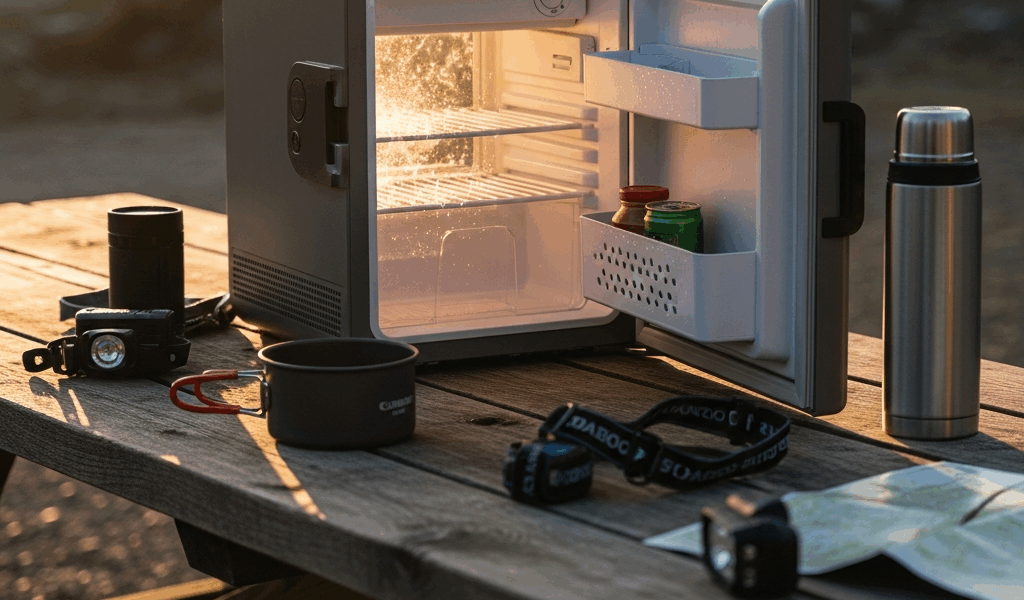
Your Overlanding Fridge Not Cooling — Here’s What to Do Right Now
Overlanding fridge troubleshooting has gotten complicated with all the forum noise flying around. As someone who’s spent four years living out of vehicles across Australia, Namibia, and the American West, I learned everything there is to know about 12V compressor fridges failing at the worst possible moment. Today, I will share it all with you.
This article includes affiliate links. We may earn a commission at no extra cost to you.
Rolling into a high-altitude camp at sunset, popping the lid on your fridge, finding warm beer and thawing meat — that feeling is genuinely awful. Not just because dinner is ruined. Because you’re three days from the nearest town and food safety is now a real problem.
Here’s the thing most people miss: a $12 multimeter sitting in your kit right now can diagnose 80% of fridge failures. A clean rag handles another chunk. You don’t need a technician. You don’t need a service center. Most of these failures — voltage issues, blocked airflow, software hangs — respond to a field fix inside 20 minutes. Probably should have opened with this section, honestly.
I’m writing this specifically for overlanding fridges: Dometic CFX series, ARB Elements, Alpicool compressor units, similar 12V rigs that live in the back of your truck — not your RV basement. This isn’t a campsite-with-hookups guide. This is what you do when you’re camped alone and the compressor goes quiet.
Quick Diagnosis — Power, Airflow, or Compressor
Before touching anything, spend 60 seconds on triage. Three questions. That’s it.
Is the LED lit?
But what is a completely dark control panel telling you? In essence, it’s a power problem. But it’s much more than that — it means the fridge hasn’t failed, your electrical system has. If the LED is on and the fridge is silent, the compressor isn’t running. If the LED is on, the fridge is humming, and nothing’s cold, you’ve got airflow or heat-rejection trouble.
Each answer sends you somewhere different. Don’t skip this step.
Can you hear the compressor?
Press your ear against the fridge body. A working 12V compressor makes a rhythmic hum — sometimes a pulse, sometimes a continuous drone depending on the model. Silence means the compressor either isn’t receiving power or isn’t getting the signal to engage. Humming with no cooling means it’s running but something downstream has failed. Two very different problems.
Is the condenser fan spinning?
Most overlanding compressor fridges — the CFX3, the ARB Elements, basically all of them — have a small fan behind a metal grille on the exterior. Shine a headlamp on it. Is the blade moving? A stopped fan means heat is trapped at the condenser coil. The fridge will warm up regardless of how hard the compressor runs. That’s the whole ballgame for airflow diagnosis.
Those three answers narrow things down to roughly 80% accuracy. Everything below flows directly from them. So, without further ado, let’s dive in.
Voltage Drop — The Most Common Cause at Camp
Frustrated by a completely dead fridge in Botswana’s Central Kalahari, I ran a diagnosis using my beat-up $14 Fluke multimeter and a piece of wire. Humbling result: the fridge was fine. My auxiliary battery read 12.1 volts at the terminals — but only 11.4 volts at the Anderson plug connector on the fridge itself. That 0.7-volt gap was enough to prevent the compressor from engaging. That was three days into a ten-day trip.
Don’t make my mistake. Test at the fridge, not the battery.
12V compressor fridges need a minimum of 12.0 volts to operate properly. Many won’t start reliably below 11.8V. This is the rule everywhere, not the exception.
Where voltage gets lost
Long cable runs bleed voltage at every junction — crimp connectors, Anderson plugs, inline fuses, relays under the hood. If your auxiliary battery sits three meters from the fridge in the truck bed, and the cable passes through four connection points along the way, each one costs you something. Undersized wiring makes it worse. A 4-gauge cable over a long run drops voltage faster than a 2-gauge. The math is unforgiving.
Corroded Anderson plugs are the second killer. Six months of dust and moisture pits the male connector. Resistance climbs. Voltage drops. The fridge dies mysteriously while the battery reads full. That’s what makes this problem so maddening to overlanders — the battery looks healthy and the fridge looks dead.
Testing voltage at camp
A cheap multimeter might be the best option, as overlanding electrical diagnosis requires real-time voltage readings at the source. That is because battery terminal readings lie — they don’t account for resistance losses downstream. I’m apparently a Kaiweets fan and their HT118A works for me while a knockoff multimeter I tried in Morocco never gave consistent readings. The Kaiweets costs $18.
- Set the multimeter to DC voltage — that’s the V with a solid line above it
- Turn the fridge off and disconnect the Anderson plug at the fridge end
- Touch the red probe to the positive terminal, black to negative
- Read the voltage. Below 12.0V means voltage drop is your problem
Test at the fridge plug. Not the battery. Not the relay. The fridge.
Field fixes for voltage drop
If voltage at the fridge reads below 12.0V, work through these in order:
Clean the Anderson connectors. Disconnect both ends of the plug — at the fridge and at the battery. Wipe the male and female terminals with a dry rag. Stubborn corrosion responds well to a pencil eraser — the rubber is mildly abrasive without being destructive. Reconnect and test. This single fix resolves roughly 40% of field voltage problems. Forty percent.
Check for loose connections. Walk the entire cable from battery to fridge. Feel every connector — relay, fuse holder, battery terminal clamp. Road vibration loosens things over weeks of corrugated tracks. Tighten by hand. Test again.
Reduce system load. Running a secondary battery charger, an inverter, and a fridge off one auxiliary battery pulls system voltage down for everything. Turn off non-essentials. On a trip through southern Utah, I turned off an inverter I’d been using to charge camera batteries — voltage at the fridge jumped from 11.6V to 12.3V and the compressor engaged within 90 seconds. The fridge hadn’t failed at all.
Plan ahead for the long haul. If voltage drop is a recurring issue, upsize the wiring on your next service visit. The price difference between 4-gauge and 2-gauge cable is maybe $40 over a two-meter run. The reliability difference is enormous.
Airflow and Heat Buildup Fixes
An overlanding fridge crammed into a drawer system, under a bench, or buried in a cabinet is fighting itself. Compressor fridges generate serious heat on the rear and sides. That heat must escape — at least if you want the internal temperature to stay cold. Block the heat, the compressor runs continuously, the internal temp climbs, the food spoils.
Minimum clearance specifications
The Dometic CFX3 manual specifies 10 cm — that’s 4 inches — of clearance on the back and sides. ARB Elements requires similar spacing. Alpicool compressor models need at least 3 inches on all sides. These aren’t vague recommendations. They’re thermal engineering requirements.
Wedge the fridge into a drawer with plywood on three sides and a blanket on top, and it will warm up — even with a healthy compressor and perfect voltage. The condenser coil simply cannot reject heat fast enough.
Blanket on top is a classic killer
Frustrated by mysteriously warm food on a muddy trip through the Lake District, I traced the problem back to an insulation blanket I’d laid over the fridge to retain cold overnight. The compressor had been running for six straight hours. The blanket had sealed the top surface completely. Internal temp had climbed to 14°C — well into the danger zone for the raw chicken I’d packed. Lesson learned the expensive way.
Never put insulation over a running compressor fridge. The heat must go somewhere. Use blankets only when the fridge is off, or in genuinely cold climates where you’re trying to prevent temperatures from dropping too low.
Creating airflow at camp
If the fridge is mounted in a drawer with limited clearance, try these — at least until you can troubleshoot properly:
- Open the drawer fully or tilt it forward to expose the rear of the fridge
- Strip off any fabric, blankets, or gear piled on top or against the sides
- If the condenser fan grille is clogged with dust or sand, use your fingers to brush it out — don’t use compressed air on electronics in the field
- Park in shade if you can — ambient temperature matters more than people realize, especially in desert environments above 35°C
These are temporary fixes, not permanent solutions. But if cooling improves dramatically the moment you expose the rear panel, you know the issue is airflow — not a failed compressor, not a power problem. That’s what makes airflow the most satisfying field fix of the three.
Model-Specific Resets and Error Codes
Different manufacturers use different control logic. A reset sequence that clears a Dometic CFX3 fault won’t do anything useful on an ARB Elements. Use the right one.
Dometic CFX — Hard Reset
LED is on, compressor isn’t humming, nothing is cooling. Try this:
- Hold the power button down for 10 continuous seconds
- Release and wait 30 seconds — full 30, not 10
- Power the fridge back on normally
This clears temporary software faults. The CFX series will sometimes lock into a protective shutdown if the internal thermostat glitches or if the compressor attempted a start under overcurrent conditions. A hard reset forces the control board to reinitialize from scratch. Takes under a minute.
ARB Elements — Extended Disconnect
The ARB Elements uses its own control logic — and it’s specific about how you reset it:
- Disconnect the power cable at the Anderson plug — fully disconnect the fridge, not just the battery switch
- Wait two full minutes with zero power reaching the unit
- Reconnect and power on normally
Two minutes is the threshold. One minute sometimes isn’t enough — I’ve tested this. The ARB’s control board locks into protective mode after low voltage events or thermal overshoot, and it needs the full drain time to clear.
Alpicool Compressor Models — Full Power Cycle
Alpicool units are stubborn. If cooling has stopped on any Alpicool compressor model:
- Disconnect power completely at the battery or relay switch — not at the fridge end
- Wait five full minutes
- Reconnect and power on
Five minutes allows compressor oil to redistribute and lets the control circuits drain completely. Alpicool firmware hangs under unstable voltage conditions — common in the field — and only a full power drain clears it reliably. Three minutes works sometimes. Five minutes works consistently.
Error codes and what they mean
Most overlanding compressor fridges display error codes on the digital panel or through LED blink patterns. “E1” typically signals a temperature sensor failure. “E3” or “E4” usually means compressor overpressure or thermal shutdown — the fridge got too hot and locked itself off to protect internal components.
See an error code? Reset first. If the error clears and doesn’t return, you’re done. If the error reappears immediately after the reset, the sensor or compressor itself has failed — and you’re in workaround territory for the rest of the trip.
When It’s Actually Dead — Field Workarounds
Sometimes the fridge is genuinely gone. Failed compressor. Fried control board. You’re three days from civilization with four days of perishable food. Here’s what actually works.
Ice block rotation method
A standard 2.5 kg (5.5 lb) ice block will keep a Dometic CFX-sized fridge cold for 8 to 12 hours in moderate temperatures. Smaller coolers stretch that to 24 hours or more depending on how often you open the lid.
The trick is rotation using two blocks. Keep one ice block in a basic $30 soft-sided cooler as backup — the Yeti Hopper M20 is overkill here, honestly any insulated bag works. Swap the melting block in the fridge with the fresh block from the backup cooler every morning. Requires access to ice, which is the obvious limitation at truly remote camps.
Frozen water bottle method
Frozen water bottles pull double duty — they cool the fridge and become drinking water as they melt. Fill bottles three-quarters full (water expands when frozen — 100% full bottles crack), freeze them solid before the trip, stack them in the fridge. As they melt over the following days, you drink them.
In moderate temperatures, this stretches perishable food two to five days. Not ideal. Better than losing $200 of groceries.
USDA danger zone and food safety
This part matters more than any technical fix. Perishable food enters the danger zone between 40°F and 140°F (4°C and 60°C) — the range where bacteria multiply fast. At 70°F ambient temperature, meat, dairy, and prepared foods are unsafe after two hours. In a 95°F desert environment, that window shrinks to one hour.
If the fridge dies and cooling isn’t immediately available, prioritize like this:
- Eat fresh meat today — tonight’s dinner, not tomorrow’s
- Use dairy products today
- Preserve anything sealed, shelf-stable, or that can sit in a shaded cool spot
- Accept that some food will spoil — it’s the cost of field living
Better to throw away $15 of chicken than to spend two days sick in a camp four hours from the nearest hospital. Don’t make that trade.
Prevention — The Real Solution
The best field fix is one you never need. Twenty minutes of preventive maintenance before any overlanding trip eliminates most of these failures entirely:
- Test voltage at the fridge plug with a multimeter — above 12.2V with the engine running, above 12.0V with the engine off
- Clean the Anderson connectors with a dry rag — both ends, every time
- Confirm clearance around the fridge — 4 inches minimum on all sides, nothing piled on top
- Listen to the compressor hum before you leave the driveway — rhythmic and consistent means healthy, stuttering or silent means investigate now
I carry a spare Anderson plug, three spare battery terminals, and a Kaiweets HT118A multimeter in my spares kit. Combined cost: under $50. Combined field saves over four years: more than I can count. That’s what makes this prep endearing to us overlanders — cheap insurance against genuinely bad situations.
Your overlanding fridge not cooling isn’t always a catastrophe. Honestly, it usually isn’t. It’s a voltage connection, a blocked fan, or a software hang sitting two feet away — waiting for 20 minutes of logical troubleshooting and a clean rag.


Stay in the loop
Get the latest trail owl updates delivered to your inbox.