Overlanding Recovery Gear You Actually Need vs Skip
The Two Recovery Situations That Actually Happen
Overlanding recovery gear has gotten complicated with all the extreme-scenario content flying around. Every forum thread assumes you’re dangling off a Moab ridgeline needing a dual-winch setup and a full trauma kit. Real beginner overlanding looks nothing like that. As someone who spent several seasons running desert trails and forest two-tracks across the Southwest, I learned everything there is to know about what actually goes wrong out there. Today, I will share it all with you.
Ninety percent of recovery situations come down to three things: a tire that went too deep into soft sand, a rear axle that settled into a mud rut, or a front end that buried itself because someone forgot to air down before the soft section. That someone was me, obviously. Don’t make my mistake. These are soft recoveries — and understanding that single category changes everything about how you pack the truck.
Recovery Gear You Cannot Leave Camp Without
These items go in the truck every single time. No exceptions. Doesn’t matter how short the route looks on the map.
Traction Boards
But what is a traction board? In essence, it’s a rigid ramp you shove under a spinning drive wheel to give it something to bite. But it’s much more than that — it’s the one piece of gear that gets you unstuck without a second vehicle, without complicated rigging, and usually in under five minutes.
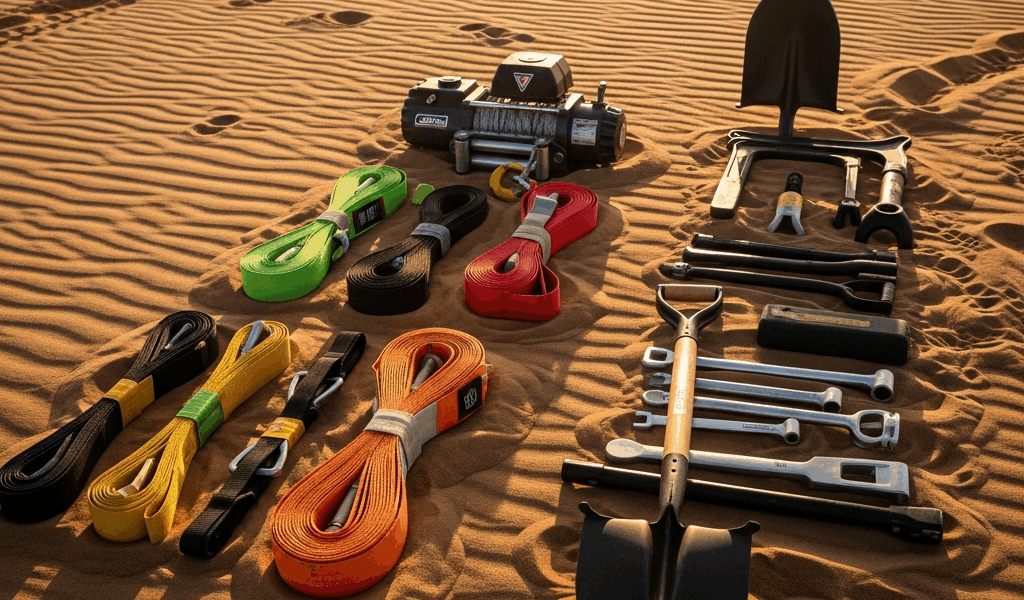
MaxTrax MKII boards run around $350 a pair and are the benchmark. ARB Tred Pro boards at roughly $250 perform nearly as well for most conditions. The spec that actually matters is load rating — you want boards rated for at least 5,000 lbs per board. Slow steady throttle and you’re out. I’ve used mine nine times in two seasons. The winch on the same truck has been used exactly once. That’s what makes traction boards endearing to us beginner overlanders.
A Rated Tow Strap — Not a Bungee Cord With Hooks
Burned by a cheap $19 strap from a gas station — it stretched, snapped back, and dented my tailgate — I now carry a Bubba Rope 20-foot kinetic recovery strap rated to 30,000 lbs minimum breaking strength. I’m apparently in the 5,500 lb truck category and Bubba Rope works for me while those mystery-brand straps never hold up past one real pull.
For most mid-size trucks and SUVs in the 5,000–6,500 lb range, you want a working load limit of at least 8,000 lbs with a 3:1 safety factor. Length matters too. Twenty feet gives you working clearance in tight trees. Thirty feet is better in open terrain.
Soft Shackles or D-Ring Shackles — At Least Two
Soft shackles weigh nothing and won’t turn into a projectile if a connection fails under load. I carry two Factor 55 soft shackles rated at 35,000 lbs breaking strength alongside two traditional 3/4-inch screw-pin D-rings with a 4.75-ton WLL. The combination covers synthetic rope connections and traditional recovery points. Don’t skip the D-rings entirely — some recovery points on older vehicles require the rigidity a soft shackle simply can’t provide.
A Shovel
Probably should have opened with this section, honestly. A full-size pointed shovel — not a folding camp shovel — is the most underrated piece of recovery equipment in any kit. Dig out around the tires before the traction boards go down. Clear mud packed into wheel wells. Reroute water pooling under the vehicle. The Fiskars 46-inch steel-headed model is $35 and weighs under four pounds. This one comes before anything else on the packing list.
A Reliable Jack — Matched to Your Vehicle
The Hi-Lift 60-inch model might be the best option for lifted trucks, as overlanding recovery requires a tool that functions as a jack, winch, and spreader in one. That is because out there, you rarely have the luxury of needing just one thing at a time. But on stock or mildly lifted vehicles without exposed frame points, an ARB EJAKKIT exhaust jack inflates under the vehicle using exhaust pressure — no hard attachment point needed. Know your vehicle before you pick one. Running a Hi-Lift on a stock RAV4 bumper deforms the bumper. Ask me how I know.
Gear Worth Adding Once You Go Remote
These items earn their space when routes get longer, help gets farther away, or you’re running solo. So, without further ado, let’s dive in.
A Winch — But Only in Specific Contexts
A quality electric winch — the Warn VR EVO 10-S runs $600 to $700 installed — makes real sense when you’re running solo in technical terrain more than 30 miles from pavement. For weekend trips with a buddy vehicle, the tow strap already covers you. Honest reality check: the winch costs as much as the rest of your recovery kit combined, requires a reinforced bumper or at minimum a receiver hitch mount, and drains your battery hard under load. Worth it for serious remote travel. Overkill for most beginner scenarios.
A Snatch Block
An 8-ton-rated snatch block — the Warn 8-ton model, about $60 — doubles your winch pulling power through mechanical advantage while letting you redirect a pull at angles the winch drum can’t reach directly. If you have a winch, you need a snatch block. If you don’t have a winch, skip it entirely. It has no other recovery application worth packing for.
A Kinetic Recovery Rope for Vehicle-to-Vehicle Pulls
Different from a static tow strap, a kinetic rope like the Bubba Rope Original stretches under load and uses momentum transfer to pop a stuck vehicle free — without shock-loading the recovery points on either rig. If you regularly travel in a group of two or more trucks, this is a smart $150 upgrade. Solo traveler who already owns traction boards? Nice-to-have. Not a need-to-have.
What Most Beginners Buy and Rarely Use
This is the section no gear roundup wants to write. Here it is anyway.
Amazon Recovery Kit Bags
You’ve seen them. A nylon bag crammed with a strap, two hooks, a tow rope, shackles, and a glove — all for $45. The straps have no visible WLL rating stamped anywhere. The shackles are stamped steel with no load specs. These kits fail under real loads and the failure mode is violent. Buy individual pieces from rated manufacturers — Warn, ARB, Factor 55, Bubba Rope — and skip the mystery bundle entirely.
Come-Alongs
A come-along ratchet puller seems like a budget winch alternative. It is not. Most top out at 2-ton capacity, move roughly four inches per ratchet stroke, and take 15 minutes to move a vehicle six feet. In soft sand where speed is everything, that’s not a recovery tool. It’s a frustration. Traction boards do the same job in two minutes. Leave the come-along at home.
Oversized Jack Base Plates
A 12-inch square Hi-Lift base plate genuinely prevents the jack from sinking into soft sand. Useful in dunes. For hardpack dirt, gravel, or rocky terrain — which describes most forest and mountain overlanding — it’s a chunk of plastic collecting dust behind the seat. A scrap of 3/4-inch plywood cut to 10 inches square does the same job and costs nothing. Running dunes regularly? Buy the real base plate. Otherwise, skip it.
How to Pack Your Recovery Kit Based on Trip Type
Weekend Desert Trail Trip — Two to Three Days, Buddy Vehicle
- Two traction boards (MaxTrax MKII or ARB Tred Pro)
- One 20-foot kinetic tow strap, 30,000 lb rating
- Two soft shackles and two 3/4-inch D-rings
- Full-size pointed shovel
- Hi-Lift or exhaust jack matched to your specific vehicle
- Tire repair kit and portable 12V compressor, 150 PSI minimum
That’s the whole list. That kit weighs under 40 lbs, fits inside a medium milk crate, and handles every realistic scenario on a desert weekend trail with another truck nearby.
Week-Long Remote Forest Route — Solo or Small Group
- Everything from the desert kit above
- Warn VR EVO 10-S winch (or equivalent), mounted and wired
- 8-ton snatch block
- Kinetic recovery rope, 7/8-inch x 20 feet
- Tree saver strap, 8-foot minimum, 30,000 lb rating
- Leather work gloves — two pairs
- Spare shackle set
The remote kit adds roughly 35 lbs and a winch install. But when you’re three days from the nearest town and the front axle is buried to the differential, that snatch block and kinetic rope earn their space ten times over. Every single pound of it.
The best recovery gear matches the actual trip you’re taking — the specific terrain, the real distance, the honest risk level. Not the worst-case fantasy trip you’re hoping to tell a story about later.

Stay in the loop
Get the latest trail owl updates delivered to your inbox.