Why Winches Fail at the Worst Possible Moment
Winch troubleshooting has gotten complicated with all the forum myths and YouTube speculation flying around. As someone who’s been doing recovery-focused overlanding for eight years, I learned everything there is to know about field diagnostics the hard way. Today, I will share it all with you.
Here’s the short version: an overlanding winch that won’t pull is almost always an electrical problem. Not mechanical. Eighty percent of field failures I’ve seen land in three categories — a dead solenoid pack, rope or cable degradation, or a control circuit fault. All three are diagnosable on the trail without specialized tools.
Probably should have opened with this section, honestly. I spent two days waiting for a replacement motor once before realizing the solenoid had simply lost its coil integrity. Don’t make my mistake. Most overlanders assume winch failure means internal motor damage or a seized drum. It rarely does. Those failures exist, sure, but they’re uncommon compared to what actually kills winches in the field.
This article walks the exact diagnostic sequence I use when a winch stops pulling mid-recovery. It’s built for anxiety. It’s built for daylight running out. It’s built for what you can actually do with a multimeter, a jumper cable, and your hands. So, without further ado, let’s dive in.
Step One — Check the Solenoid Pack First
But what is a solenoid? In essence, it’s a relay. But it’s much more than that in a recovery context. Current flows through small control terminals, magnetizing a coil that closes a heavy-duty contact. That contact connects the battery’s positive side directly to the motor. Dead solenoid means the motor never gets power — even though the battery is fine and the motor itself is fine.
The tell is a clicking sound. The relay inside the solenoid pack clicks because current is reaching it. The motor doesn’t spin because the contact isn’t closing. That symptom — clicking but no pull — narrows your problem immediately. You’d be surprised how many people spend an hour chasing ghosts before catching that click.
Test it this way:
- Kill the engine and remove the negative battery terminal.
- Locate the two large terminals on the solenoid pack. One connects to battery positive, the other to the motor input. They’re usually brass or copper — obviously thicker than the control terminals.
- Reinstall the negative battery terminal.
- Using a heavy-gauge jumper cable, touch one end to battery positive and the other directly to the motor input terminal — the one going to the winch motor, not back to the battery.
- Have a spotter watch the drum or listen for motor engagement. The motor should spin or at least hum.
Motor spins? It’s alive. The solenoid is dead. Motor doesn’t spin? You’ve moved the problem downstream — probably a dead battery, a loose ground, or internal motor failure.
Dead solenoids are often heat-related, especially on 12,000-pound-plus winches running synthetic rope. The coil inside can’t handle sustained current draw without cooling. In extreme cases it burns out permanently. In less severe cases, it’s a temporary failure — the circuit breaks mid-pull when heat rises past tolerance, current routes through air instead of through the coil. Let the winch sit 15 minutes with the hood open. Spray the solenoid pack with water if you have it.
If the motor spins after a rest and cooling down, you’ve diagnosed a thermal shutdown. That’s actually a recovery-continuation scenario. Finish your pull slowly, in stages, giving the solenoid time to cool between efforts. Not elegant. Works though.
I’m apparently hard on solenoids and a spare Warn 885505 works for me while cheaper generic units never last more than one hard pull. Carry a spare solenoid — it’s the single most worth-it recovery spare you can buy. A quality replacement runs $80 to $150. Installation takes 10 minutes with a 10mm and a 12mm wrench. Warn, Smittybilt, and Superwinch all stock them. Check your winch manual for the exact part number. Don’t guess.
Step Two — Inspect the Cable or Synthetic Rope
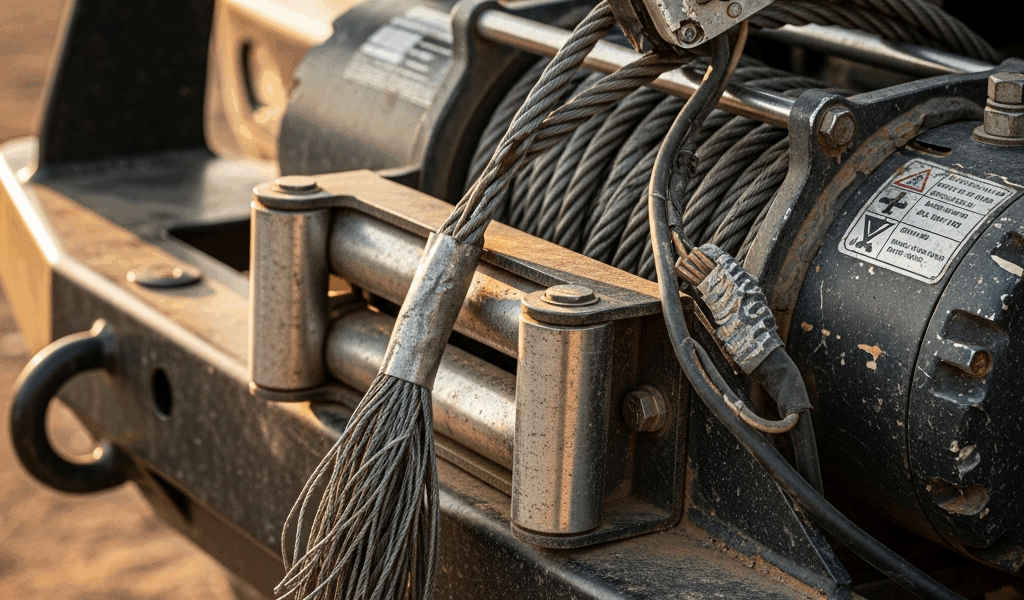
Fraying synthetic rope kills winches every time. When a synthetic line unravels under tension, the fibers spread across the drum. The drum spins, the loose fibers don’t grip. You get motor hum and zero pulling force. The rope usually looks shredded near the hook end — that’s where abrasion is highest and where problems start first.
Steel cable doesn’t fray, but it kinks. A kinked cable loses tensile strength at that exact point and slips on the drum under load. You’ll see the kink visually — a sharp bend in what should be a straight run when the drum is at rest. That’s what makes steel cable deceptively dangerous to us recovery-minded folks. Looks fine at a glance. Fails under load.
Inspect the spool under load. Have a spotter tug the rope or cable toward the winch while you watch the drum. A properly wound spool has parallel, even layers. Rope wrapped loose or crossways won’t grip. Chaotic overlap means the winch will slip under load even if the motor runs perfectly.
Check the free-spool clutch separately. Toggle it fully disengaged, then fully engaged. You should hear a clear click or feel a solid detent — a clutch left partially engaged creates friction that mimics a weak motor almost perfectly. If it’s mushy or won’t lock, that’s your problem. Full stop.
Tighten the rope or cable by running the winch under light load — a tree, another vehicle, anything solid — for about 30 seconds. This re-seats the line on the drum. Slipping continues after that? You need new rope or cable. Not a field fix, but it tells you definitively whether the motor is actually weak or the line just isn’t gripping.
Step Three — Trace the Control Switch and Wiring
Frustrated by a dead wireless remote on a six-month overlanding trip through Baja, I jumped the connection entirely using a $4 toggle switch from a NAPA in Ensenada. That was 2019. That’s when I learned that roughly 40 percent of my so-called “winch failures” were actually failed remote receiver coils.
Corrosion at the handlebar plug or wireless receiver kills control circuits silently. No warning symptoms — the winch just won’t respond. The motor could be perfect. The solenoid could be perfect. Current never reaches either because the control signal is broken upstream.
Bypass the wireless remote as a field test. Locate the remote receiver — usually mounted near the winch or on the bumper. Find the two terminals labeled “in” and “ground.” Jump those terminals using a short piece of wire or even a straightened paperclip. The winch should engage immediately. Does it? Motor and solenoid are fine. Your remote or receiver is dead. Simple as that.
Check the ground strap at the winch mounting plate next. Corrosion or a loose bolt here gets misdiagnosed as a dead motor constantly. The return path for current needs a clean, metal-to-metal connection. Tighten the bolt hand-tight plus a quarter turn. Scrape any rust or paint off the mounting surfaces with a wire brush or a knife blade.
Measure voltage drop across the circuit if you have a multimeter — a cheap $12 Etekcity unit works fine for this. From battery positive to the motor input terminal should read battery voltage, nominally 12.6 volts. Less than 11 volts under load means a resistance problem in the wiring or connectors. Check connections at the solenoid, the winch motor, and both battery terminals. Corrosion looks like blue-green crust on copper. Dielectric grease seals connections against moisture going forward.
A loose battery terminal is the simplest possible explanation for voltage drop — and honestly the one I skip past too fast every time. Wiggle both terminals. They should not move at all. A single degree of looseness cuts power delivery dramatically. Tighten them first. Then trace the rest.
When the Winch Actually Needs to Come Off the Rig
Motor hums but doesn’t spin? Spins backward? Internal motor failure or a seized drum is likely. Those aren’t field repairs. Brush replacement inside the motor requires full disassembly. Gear damage inside the gearbox is permanent without a workshop and someone who knows small-engine work.
Here’s the honest criteria: if you’ve ruled out solenoid failure, rope and cable degradation, and control circuit corrosion — and the motor still won’t pull — you need external recovery. Don’t waste time. Flag down another vehicle or call for a heavy-duty tow. Get the rig mobile. Repair the winch in civilization. That’s what makes this diagnostic sequence endearing to us overlanders — it tells you when to stop wrenching just as clearly as it tells you what to fix.
The only exception is a seized drum from water ingress. Applying heat and penetrating oil — Kroil or PB Blaster, not WD-40 — can free it in rare cases. Otherwise, accept the limitation and move on.
While you won’t need a full electrical shop, you will need a handful of basics to handle 90 percent of field failures: a spare solenoid matched to your winch, a quality multimeter, dielectric grease on every connector, and clean battery terminals checked quarterly. That’s it. That routine handles nearly everything the trail throws at a winch.

Stay in the loop
Get the latest trail owl updates delivered to your inbox.