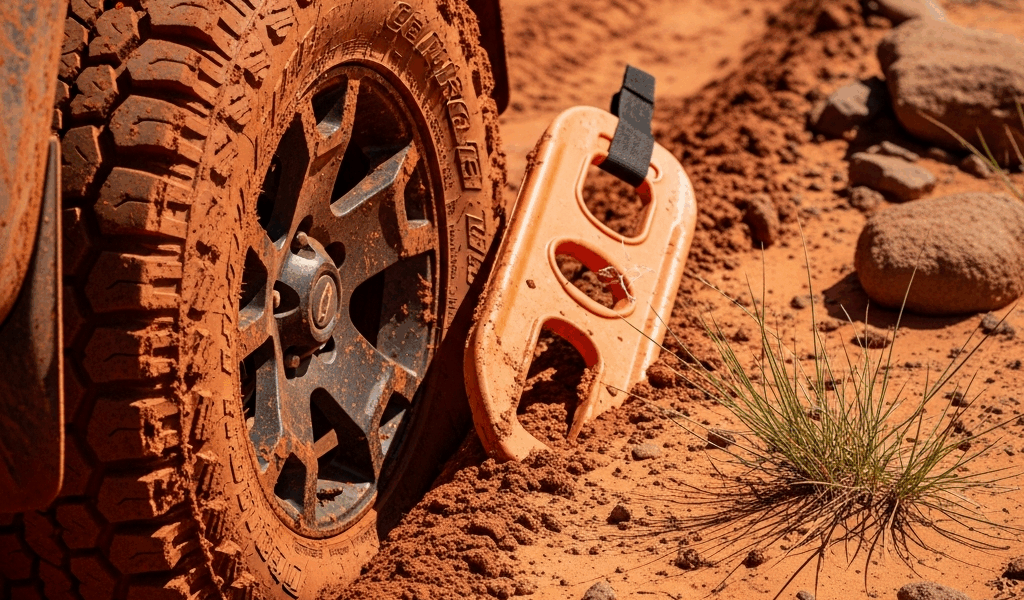
Why Traction Boards Fail More Than People Admit
Overlanding recovery has gotten complicated with all the gear marketing and “foolproof” promises flying around. As someone who has spent years dragging vehicles out of sand, mud, and snow across some genuinely nasty terrain, I’ve learned everything there is to know about why traction boards stop working at the worst possible moment. Today, I will share it all with you.
Here’s the thing nobody wants to hear: the boards are usually fine. I’ve watched recoveries go completely sideways — literally, in one case involving a Jeep on a slickrock slope outside Moab — and the boards were sitting right there, unused, while the driver blamed them anyway. The failure lived somewhere between the gear and the human holding the keys. After pulling myself and others out of genuinely ugly situations more times than I’d like to count, I’ve gotten good at finding the actual breaking point before anyone starts blaming their equipment.
Four reasons. That’s what we’re covering. None of them are defects. All of them are fixable once you actually understand what went wrong.
You Placed the Boards Wrong for That Terrain
Placement breaks more recoveries than anything else. More than board quality. More than throttle mistakes. More than vehicle weight. The boards themselves are almost never the problem.
In Sand — You Didn’t Dig Out First
Sand is deceptive in a way that catches people off guard every single time. Your tire sinks. You assume you’re close to the board surface. You’re not. Compressed sand underneath the tire creates a pocket — sometimes 4 to 6 inches deep — that never actually reaches the board. You hit the throttle, the tire spins furiously inside that pocket, and the board just sits there doing absolutely nothing useful.
Probably should have opened with this section, honestly. I spent three hours stuck in the Mojave Desert in 2019 learning this exact lesson with a shovel, a $280 Maxtrax, and nobody around for twelve miles. Before you place boards in sand, dig. Use your hands or a folding shovel to carve a shallow ramp from the tire down to packed sand beyond the spin zone. The board goes on that ramp — positioned so the tire makes actual contact — usually 6 to 8 inches ahead of the deepest part of the rut.
Feel the sand as you dig. Firm, not loose. The board should sit flush with no gaps underneath it. Rock it side to side. If it moves, you missed a spot.
In Mud — The Board Is Behind the Spin Zone
Mud works the opposite way. The tire spins, throws mud backward, and suddenly the board has migrated behind where the tire is actually digging. The tire never touches it. That’s what makes mud so frustrating to us overlanders who think we’ve done everything right — we have, except for this one thing.
Get on your hands and knees in front of the drive tire. Visualize the arc the tire cuts as it rotates. That arc is where the board needs to start. Most people place boards 12 to 18 inches too far back. Push them forward until the top edge aligns with the tread at its closest point. Don’t guess. Measure with your hands.
On a Slope — The Angle Is Wrong
Gravity changes everything. A board placed flat on a slope angles downhill automatically. The tire climbs on, immediately slides off the other side, and the board becomes a ramp that launches you sideways into whatever happens to be there. Don’t make my mistake — I ruined a set of boards and a running board on a 15-degree slope in Colorado before I figured this out.
Angle the board so it tilts slightly back toward the hill. Dig into the downhill edge just enough so the top surface faces uphill. The tire grips instead of rolling off. Wiggle the board after adjusting it. If it shifts under your hands, it will shift under a 5,000-pound vehicle.
Your Tires Are Spinning Too Fast or Too Slow
Throttle control is honestly what separates a clean recovery from the kind that ends with a board embedded in someone’s bumper. So, without further ado, let’s dive in on what actually goes wrong here.
Too much throttle and the board launches backward like it was fired. The tire never climbs — it just spins faster and ejects the board behind it. I watched this happen to a lifted Tacoma running 35-inch BFGoodrich KO2s outside of Flagstaff. Driver floored it, board flew about 15 feet back, nearly caught a bystander in the shin. The board was fine. The technique was not.
Too little throttle and the tire just grinds. No forward movement. Tire smoking slightly. Board staying exactly where it is. You’re getting nowhere.
The technique is feathering — slow, deliberate throttle input. Press gradually. Listen for the tire tone to shift from a frantic, high-pitched spin down to something lower and gruntier as grip starts to develop. Feel for movement in the vehicle. It should inch forward, not surge. Once you feel that momentum, hold the throttle steady. Small corrections only. Don’t get excited and add more.
I’m apparently a light-footed driver and feathering comes naturally to me, while every full-throttle approach I’ve ever tried has ended badly. Aggressive all-terrain tires with deep lugs — your MT/R Kevlars, your TSL Boggers — grip faster and need less throttle. Street-biased tires need more gentleness. Aired-down tires grip sooner than aired-up ones, sometimes dramatically so. If you just dropped from 45 PSI to 18 PSI for the trail, recalibrate your expectations immediately.
The Board Is Wrong for Your Vehicle Weight or Tire Size
But what is the right board? In essence, it’s a rated piece of recovery equipment matched to your specific vehicle and tire combination. But it’s much more than that — it’s also a size calculation most people skip entirely.
Budget boards flex. Maxtrax clones made from thin polymer bend visibly under real weight. I’ve watched a $90 clone board fold in half under a loaded 4Runner — not crack, fold — before shooting sideways out from under the tire. A genuine Maxtrax MKII runs around $280 per board. Clone boards run $80 to $120. The gap is material thickness and actual load rating, not branding.
Short boards fail on oversized tires just as reliably. A 40-inch tire needs at least 47 inches of board length to climb completely. Shorter than that and you’re on an angle that either launches the vehicle or drops it back before gaining any real traction. Running 35-inch tires on 36-inch boards? Too short. You’ll feel it immediately.
Check the load rating on your boards against your vehicle’s curb weight plus whatever you’re hauling. Most reputable boards list this clearly. If yours doesn’t — that’s your first red flag, honestly. Measure your tire diameter. Board length should be at least equal to that measurement, ideally 6 to 10 inches longer for reliable climb-through contact.
Watch the board during your first attempt. Visible flex? It slides? Tire loses contact at the midpoint? All signs the board is undersized for the job.
What to Do When the Boards Still Won’t Get You Out
Sometimes boards alone aren’t enough. The terrain is too soft, the vehicle too heavy, the angle too steep. That’s normal. Boards are one tool in a stack — not the whole answer.
[X] might be the best option when boards alone fail, as recovery in serious terrain requires a layered approach. That is because soft or steep conditions overwhelm any single piece of gear. Combine boards with a Hi-Lift or ARB air jack to lift the vehicle first, then place boards deeper under the tire. Use an anchor — a tree, another rig, a deadman plate buried in sand — and run a strap or winch line to pull while you apply throttle. The boards provide the grip, the strap provides the directional force, and together they actually work.
While you won’t need a full recovery kit for every situation, you will need a handful of tools working together when things go genuinely wrong. Before your next attempt, run through this: Is the board positioned where the tire will actually contact it? Is the angle correct for this specific terrain? Are you feathering throttle or dumping it? Is the board rated for your vehicle’s weight and tire size? Answer no to any of those — fix it first. You’re closer to getting out than you think.

Stay in the loop
Get the latest trail owl updates delivered to your inbox.