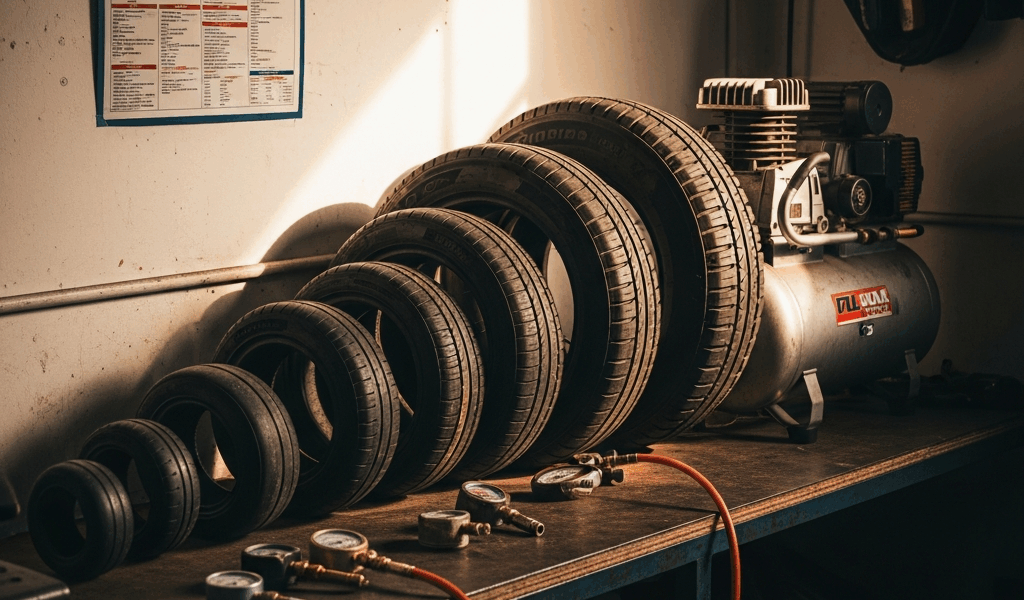
Why Compressor Size Actually Matters on the Trail
Picking an overland air compressor has gotten complicated with all the spec sheets, brand loyalty arguments, and “budget pick” roundups flying around. As someone who destroyed a compressor on day two of a Moab trip, I learned everything there is to know about matching compressor size to actual tire setups. Today, I will share it all with you.
Here’s what happened. Midway through day two, I needed to air up from 18 PSI to 32 PSI on 35-inch tires. The compressor I’d grabbed — a compact unit, maybe $89 on sale, can’t remember the exact model — ran continuously for nearly 40 minutes. The housing got so hot I couldn’t touch it. Then came a grinding sound. Then silence. It never started again.
That was somewhere around mile 60 of a 140-mile route with no cell service.
The two numbers that separate a capable compressor from a paperweight are CFM and duty cycle. CFM — cubic feet per minute — is the volume of air the unit actually moves. Duty cycle is the percentage of time it can run without overheating. Buy wrong on either one and you’re either waiting 90 minutes for a single tire or watching your motor cook itself alive. A 33-inch tire and a 37-inch tire are not the same conversation. Neither are weekend day trips and multi-day expedition work.
How to Match CFM and Duty Cycle to Your Tire Size
So, without further ado, let’s dive in.
| Tire Size Range | Minimum CFM | Required Duty Cycle | Best For |
|---|---|---|---|
| 31–33 inch | 2.0–3.5 CFM | 25–40% | Weekend tripper, compact vehicles |
| 34–35 inch | 3.5–5.0 CFM | 50–60% | Daily driver, frequent re-inflation |
| 36–37 inch | 5.0–7.0 CFM | 70%+ | Serious overlander, multiple airing cycles |
| 38+ inch | 7.0+ CFM | 80%+ | Expedition rig, frequent airing |
Probably should have opened with this section, honestly. But the Moab story felt important.
CFM is the speed at which your compressor refills a tire. A 35-inch tire holds roughly 40 percent more air volume than a 33-inch tire at the same pressure. Air down from highway pressure — around 35 PSI — to trail pressure around 18 PSI, then back up again three times in a single day, and you need enough CFM to do that repeatedly without cooking the motor. That’s what makes raw CFM numbers matter to us overlanders more than any other spec on the box.
Duty cycle is the silent killer. It’s the percentage of time a compressor can run at full capacity before the thermal relief valve triggers and shuts the unit down to cool. A 25 percent duty cycle means 15 minutes of runtime, then a 45-minute cool-down. Fine for topping off tires once a month in your driveway. Catastrophic on a rocky trail in July with three more tires to go.
Real example: airing up 37-inch tires from 15 PSI to 35 PSI after dropping a canyon requires sustained output. A 3.0 CFM compressor needs 45 to 60 minutes for that job. Pair that with a 25 percent duty cycle and it shuts down after 10 or 15 minutes — you’re waiting in the heat while other rigs drive past. A 7.0 CFM unit running at 70 percent duty cycle finishes in about 12 minutes and stays cool the whole time. Don’t make my mistake.
Best Compressors for 33-Inch and Smaller Tire Setups
Running 31 to 33-inch tires — compact overlanders, light trail rigs, weekend campers — you don’t need industrial equipment. But what is the right tier here? In essence, it’s a portable unit with honest limits and enough duty cycle to air up all four tires before the motor complains. But it’s much more than that — it’s about matching what you actually do on the trail to what the compressor can actually handle.
ARB Single Compressor
3.0 CFM, 25 percent duty cycle, roughly $250.
The ARB Single is the gateway compressor. Metal housing, reliable power cord, decent built-in gauge. Small enough to fit in a door pocket — I’ve seen people store these under a seat. You’ll inflate a 33-inch tire from 15 to 35 PSI in about 18 minutes, which is acceptable for occasional trail use. The honest downside: that 25 percent duty cycle means sequential airing on a hot day will trigger the thermal relief. Air one tire, wait. Air another, wait. Manageable if you plan for it. Frustrating if you don’t.
Viair 300P
2.7 CFM, 33 percent duty cycle, roughly $200.
Lighter and cheaper than the ARB Single. The 300P ships with a decent carry bag and hose kit — the bag alone is worth something if you’re tired of gear rattling loose in a drawer. Build quality is lighter too, which is the honest trade-off. I’m apparently a bag-quality person and Viair’s kit works for me while cheaper nylon bags never hold up past a season. The 33 percent duty cycle is a marginal improvement over the ARB Single, but not a game-changer. This is weekend warrior territory, not daily airing territory.
Smittybilt Air Compressor
2.4 CFM, 30 percent duty cycle, roughly $150.
The value play. Air down once per trip and care mainly about budget — this unit gets the job done. The pressure gauge accuracy is sometimes suspect right out of the box, which matters more than people realize. I’ve seen these run reliably for years on lightly-used rigs and I’ve seen them struggle after a single hard season. Not premium. Not a waste of money. Just know what you’re buying.
Best Compressors for 35-Inch and Larger Tire Setups
Running 35-inch tires or larger demands a different tier entirely. You’re committing to more frequent airing cycles, longer trail days, and terrain that genuinely punishes equipment. Cheap here becomes false economy fast — and I mean fast, as in 150 miles from pavement fast.
ARB Twin Compressor
5.6 CFM, 40 percent duty cycle, roughly $450.
Two pistons instead of one. The jump from Single to Twin is real — meaningful CFM gains and noticeably better cooling. A 35-inch tire goes from 15 to 35 PSI in roughly 10 minutes. A full set of four takes 35 to 40 minutes without thermal shutdown. The 40 percent duty cycle is the actual upgrade here — consecutive tire airing without waiting. Mounting options are flexible: underhood installation works if you have space, but the portable bracket setup fits better on expedition rigs that move gear around between trips. This is the sweet spot for serious daily drivers and overlanders running 35 to 37-inch setups. That’s what makes the ARB Twin endearing to us in the 35-inch-and-up crowd.
Viair 450P-Automatic
5.2 CFM, 50 percent duty cycle, roughly $500.
The 450P-Automatic adds digital preset capability — set your target pressure on a small display, and the unit shuts off automatically when it hits that number. Sounds trivial. It’s not. On a long expedition where you’re airing up four times a day, not staring at a gauge and manually killing the power saves real attention. The 50 percent duty cycle handles rapid sequential airing without complaint. Viair’s build quality is genuinely premium. Downside: it runs louder than the ARB Twin — noticeably so — and the digital display adds one more thing that could fail, though failures are rare in practice. If you value automation and cycle life, this unit is worth the extra $50 over the Twin.
Honesty about 37-Inch and Larger Tires
If you’re running 37-inch or larger tires and trying to stretch a 33-inch-rated compressor to cover the gap — stop. You’ll spend 90 minutes airing up. The motor will cycle on and off repeatedly. You’ll resent every budget decision that led to that moment, standing on a trail at dusk with one tire still flat. Budget the $400 to $600 for a unit rated for your actual tire size. Sanity is worth it. So is getting home before dark.
Features Worth Paying For and Ones You Can Skip
The compressor market is cluttered with features that sound essential and aren’t, and others that sound optional and absolutely matter.
Pay for automatic shutoff — at least if you’re running multiple airing cycles per day. The Viair 450P has it built-in. ARB units can be paired with external regulators that add the function. It prevents overpressurization and frees you to do something other than watch a gauge needle.
Pay for a quality pressure gauge. Budget compressors often ship with gauges reading 2 to 5 PSI off from actual pressure. On the trail, a 2 PSI error represents a roughly 15 percent difference in tire load. ARB and Viair gauges read accurately. No-name alternatives sometimes don’t — and you won’t know until you check against a known-good gauge and get a surprise.
Pay for a moisture trap if you’re running expedition trips in humid climates. Water in your tire degrades the sidewall over time. An inline trap runs about $30. A replacement sidewall runs $200 or more. Easy math.
Pay for carry bag durability if portability matters. Cheap nylon tears at the handle seams after one season. Reinforced bags with metal or rubberized handles last years of real use.
Skip the digital thermometer add-on. A compressor too hot to touch is a compressor that needs to cool down — you don’t need a readout to figure that out.
Skip ultra-compact “emergency” models for real overlanding work. They overheat on actual sustained use and inflate at speeds that will test your patience.
Skip fancy paint and branded carry cases. You’re buying CFM and duty cycle. The aesthetics don’t move air.
Here’s the bottom line: match your compressor’s CFM and duty cycle to your actual tire size and your actual trip frequency. Weekend tripper with 33-inch tires? An ARB Single or Viair 300P covers you — around $200 to $250, done. Daily driver or expedition rig on 35-inch-plus rubber? Jump to the Twin or 450P tier and thank yourself somewhere around mile 200 of a remote route when the compressor is still running fine. The sizing table above is your anchor. Use it. The money you spend buying right the first time is money you don’t spend replacing a burned-out unit in the middle of nowhere.

Stay in the loop
Get the latest trail owl updates delivered to your inbox.