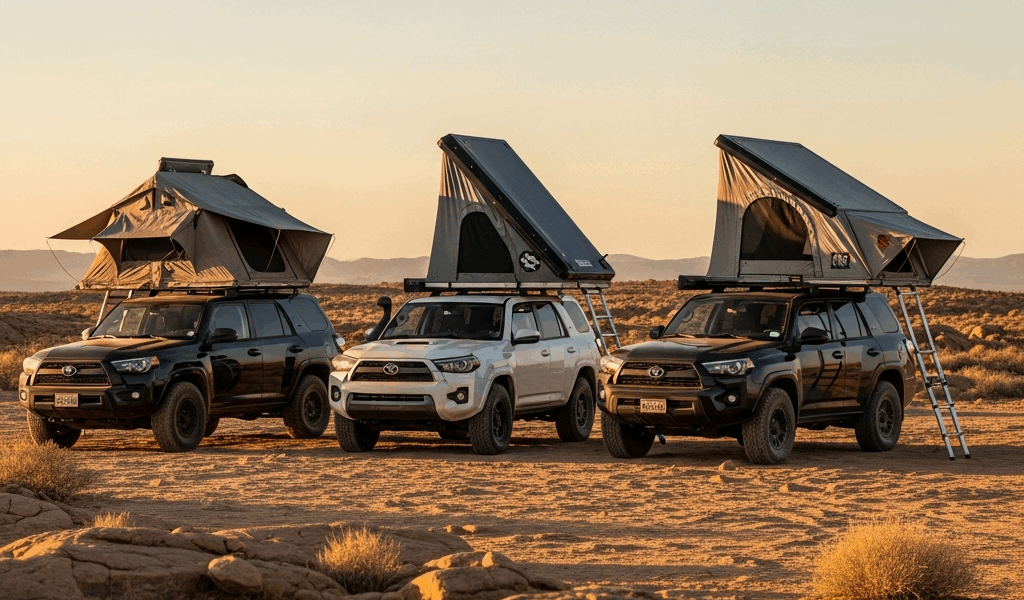
GFC vs iKamper vs Roofnest — Which Rooftop Tent Is Worth the Money
Rooftop tents have gotten complicated with all the sponsored content and brand hype flying around. As someone who has slept in enough of these things to know the difference between a marketing photo and a 19°F night in November, I learned everything there is to know about what separates a genuinely good rooftop tent from an expensive mistake. Today, I will share it all with you — GFC, iKamper, Roofnest, no brand deals, no affiliate pressure. Just what actually matters when you’re about to drop $3,000 or more on something bolted to your roof.
Three Premium Tents — GFC, iKamper, and Roofnest
These brands didn’t end up at the top of the market by accident. But they got there for very different reasons — and those reasons determine who should buy which one. Price alone tells part of the story. The GFC Platform Camper runs $2,650 to $3,200 depending on configuration. The iKamper Skycamp 3.0 sits at $3,499 retail. Roofnest’s Condor and Condor OVX land between $2,195 and $2,695. None of these are impulse buys.
But what is GFC? In essence, it’s a Montana-based company — Manhattan, Montana, specifically — that builds rooftop tents the way you’d build a truck bumper. But it’s much more than that. The design philosophy is essentially “aluminum everything, weld it shut, call it done.” iKamper comes out of South Korea with serious industrial design credentials. The Skycamp line looks like something that belongs on a Cybertruck — that’s not accidental, they’re chasing lifestyle buyers as much as hardcore overlanders. Roofnest is based in Denver and covers the widest range of shell types and sizes, making them the most accessible of the three for people with different vehicles and tighter budgets.
All three are hard-shell tents. All three sleep two adults without serious complaints. The differences live in weight, insulation, interior volume, and — this one matters more than people admit — whether you can get a human being on the phone when something breaks.
GFC Platform Camper — The Overbuilt Option
Stumbled into my first look at a GFC at an overlanding meetup outside of Moab, and my first reaction was that someone had built a small aircraft onto the roof of a Tacoma. The Platform Camper is a dual-wall aluminum tent with a fabric middle section that folds down flat. It weighs approximately 190 pounds. That’s not a typo. Most hard-shells run 100 to 130 pounds — the GFC is playing a different game entirely.
That weight buys you things, though. Real things. I’ve watched GFC tents take direct tree branch contact and hailstorms without visible damage. The dual-wall aluminum construction with a thermal break means the shell doesn’t conduct cold into the sleeping surface the way single-skin tents do. Camping in the GFC at temperatures below 20°F is manageable with a quality sleeping bag — it doesn’t fight you. That’s the standard I care about.
What the GFC Gets Right
- Full aluminum construction — top, bottom, sides, no exceptions
- Best cold-weather insulation of the three by a meaningful margin
- Made in the USA with actual accessible customer service
- 500D fabric side panels — these do not fail quietly
- Built-in gear loft and configurable window options
The Real Downsides
190 pounds is genuinely limiting. You need a serious rack — a Prinsu, an Alu-Cab, an ARB — rated for dynamic loads above 165 pounds. That’s an $800 to $1,500 investment on top of the tent. The GFC also takes over the entire roof. You’re not strapping a RotoPax to the side or mounting MaxTrax on the panel. The tent is the roof. Full stop.
By the time you’ve bought the tent, a compatible rack, and paid shipping from Montana, you’re looking at $4,500 to $5,500 all-in for most setups. That’s a serious number. Setup time is also slightly longer than a pure clamshell hard-top — you’re unfolding a system, not just popping a lid. Not a dealbreaker, but worth knowing before you’re doing it alone in the dark at a dispersed site.
The other thing nobody talks about enough — the GFC has a specific look. It announces itself. Some people love that. If you’re driving a family SUV and trying to blend in at a state park campground, this tent will not cooperate with that plan.
iKamper Skycamp 3.0 — The Popular Choice
The iKamper Skycamp 3.0 is probably the most recognizable rooftop tent on the road right now. The clamshell oval profile, the enormous interior when deployed — it photographs beautifully, and iKamper’s marketing team absolutely knows it. I’ll admit I almost bought one before I did more digging. The 3.0 improved on earlier versions in meaningful ways: better ventilation design, a redesigned ladder, tighter panel fitment. Retail is $3,499 for the standard version. That’s what you’re walking in with.
Interior space when open is legitimately impressive. The Skycamp 3.0 unfolds into a 56 x 96-inch sleeping surface — that’s king-size territory. Couples who’ve been cramped in a standard 48 x 80-inch configuration notice the difference immediately. The stock 2.5-inch foam mattress is one of the better factory mattresses across all three brands. Setup with two people is around 60 seconds once you’ve practiced it twice. That part is real.
What the iKamper Gets Right
- King-size sleeping area — best interior square footage of the three
- Fast clamshell deployment, genuinely fast
- Strong factory mattress at 2.5 inches thick
- Lower weight than GFC at approximately 132 pounds
- Improved ventilation design with the 3.0 update
Where iKamper Falls Short
The fabric panels are the weak point — thinner material than GFC’s 500D, and they show wear faster. Condensation is a known issue in cold weather. Moisture builds on the interior of the hard shell and drips onto the sleeping surface on cold nights. I’ve experienced this firsthand on October nights in the high desert of Nevada — manageable with active ventilation, but it requires active management. Not passive comfort. That distinction matters when it’s 2 a.m. and 34°F outside.
Customer service is the other honest concern. iKamper is a South Korean company with US distribution out of a California warehouse. Getting warranty support or replacement parts has been frustrating for a notable number of buyers — this shows up consistently in forum threads and Reddit posts going back several years. It’s not a rare edge case. If something breaks on your GFC, you call a guy in Montana and usually get an answer that day. iKamper’s process is slower and considerably less personal.
The tent also sits higher on the vehicle when closed than either competitor. That affects fuel economy on highway drives and parking garage clearance in ways people seriously underestimate until the third road trip.
Roofnest Condor — The Middle Ground
Roofnest doesn’t get the same social media hype as GFC or iKamper. That’s partly why I think they deserve a harder look. The Condor OVX — their flagship hard-shell — retails around $2,495 and weighs approximately 120 pounds. For a lot of vehicle setups, that weight difference over the Skycamp isn’t trivial. It’s the difference between a rack upgrade you need and one you don’t.
The Condor has a notably lower aerodynamic profile than the Skycamp when closed. Highway fuel economy on long drives is measurably better with a lower-profile tent — and if you’re driving a 4Runner or a Wrangler 800 miles to reach your trailhead, that gap adds up to real money across a season. Roofnest also offers the widest ladder angle adjustment of the three brands. Small detail. Matters a lot when you’re parked sideways on a hillside at a dispersed site.
What the Condor Gets Right
- Best aerodynamic profile when closed — lowest drag penalty on the highway
- Lightest of the three at approximately 120 pounds
- More affordable entry point without a serious quality compromise
- Denver-based company — US customer service that’s actually accessible
- Wide ladder angle range, genuinely useful on uneven terrain
The Honest Weaknesses
The interior is smaller. The Condor OVX sleeps two adults at 48 x 88 inches — fine for most couples, noticeably tighter than the Skycamp 3.0’s king configuration. Tall people notice. People who move around in their sleep notice. If interior square footage is a priority, Roofnest is not your answer.
Cold-weather insulation is also the weakest of the three at baseline. The Condor’s shell and fabric don’t hold heat the way GFC’s dual-wall aluminum does. Roofnest has addressed this with Pro versions and optional insulation add-on kits, but stock — the Condor is a three-season tent. Take it into hard winter camping unmodified and you’ll feel it by 3 a.m.
Build quality is solid but not exceptional. The latches, hinges, and hardware feel slightly less refined than GFC’s all-welded construction. Nothing has felt flimsy in actual use — but the gap between Roofnest and GFC in fit and finish is visible when you’re standing next to both at the same campsite.
Probably should have opened with this section, honestly — because the Condor is where most people should start their research. It makes the most sense for the most people. But everyone wants to hear about the extremes first.
The Verdict — Match the Tent to Your Use
There’s no universally best rooftop tent here. There’s the right tent for how you actually camp, what vehicle you’re running, and what your real budget looks like when you factor in the full setup cost — rack, shipping, accessories. So, without further ado, let’s dive in.
GFC Platform Camper — For the Dedicated Overlander in Cold Weather
Buy the GFC if you’re running a full-size truck or a heavy-duty mid-size with a high-capacity rack, you camp below 30°F regularly, and durability is the priority above everything else. This tent is for people who camp hard and often — 40 or 50 nights a year in variable conditions. The weight penalty is real. The all-in price with a quality rack is significant. Neither of those things matters if you’re living in this tent through October in the Sierras every year. Driven hard by years of desert and mountain use, the GFC shows it — by looking exactly the same as the day it was installed. That’s the value proposition.
Not the right choice for anyone with a smaller vehicle, anyone parking in urban garages regularly, or anyone doing three summer weekend trips a year and calling it a season.
iKamper Skycamp 3.0 — For the Weekend Warrior Who Wants Comfort
Buy the iKamper if sleeping space matters more than anything else, you camp primarily spring through fall, and you’re comfortable managing condensation with proper ventilation habits. The king-size mattress surface is genuinely more comfortable than either competitor. Couples who want rooftop camping to feel like camping — not surviving — will appreciate that interior on a warm June night in the Cascades.
Go in knowing the customer service timeline and knowing the fabric panels show wear faster than GFC’s material. The 3.0 version addressed enough of the early Skycamp complaints to be a confident recommendation. At $3,499, you’re paying a premium for interior space and setup speed. You’re getting both.
Not the right choice for cold-weather overlanders, anyone with low patience for warranty processes, or anyone who wants to mount additional gear on the rooftop system.
Roofnest Condor — For the Budget-Conscious Buyer With a Lighter Vehicle
Buy the Roofnest Condor if you’re driving a 4Runner, a Subaru Outback, a Jeep Gladiator, or any vehicle where every pound on the roof matters. The 120-pound weight and aerodynamic profile make it the most vehicle-agnostic of the three. At $2,495, you’re also leaving room in the budget for a better sleeping bag, an ARB 50-quart fridge, or the rack itself — things that matter just as much as the tent.
The smaller interior and weaker cold-weather baseline are real limitations. Know them going in. For three-season camping in a realistic pattern — weekends, a few longer trips, maybe one shoulder-season push into October — the Condor handles the job. Without making you spend $5,500 to do it.
Not the right choice for tall couples who need that extra width, anyone pushing into serious winter camping without modification, or anyone who will quietly regret not buying the best version of something. You know who you are.
One Last Honest Note
Don’t make my mistake. Early on I prioritized how a tent looked in photos over how it performed in the specific conditions I actually camp in. Bought a soft-shell once because the price felt right — used it twice in the rain and learned what “weather resistant” means versus “weatherproof.” I’m apparently someone who camps in rain and shoulder-season cold more than I admitted to myself, and a three-season soft-shell works for exactly none of that while a dual-wall hard-shell never fails me.
These three tents are all genuinely good. The question is only whether they match your actual use — not your aspirational use, not your Instagram use. Your actual use. Weight, temperature range, interior space, and customer service access. Run those four criteria honestly against all three brands and the right answer shows up faster than any comparison article can deliver it.


Stay in the loop
Get the latest trail owl updates delivered to your inbox.