Why Your Fridge Is Killing the Battery
Overlanding power management has gotten complicated with all the conflicting advice flying around. As someone who got stranded at a Utah campsite with a dead starter and a perfectly cold beer I couldn’t celebrate with, I learned everything there is to know about overlanding fridge battery drain. Today, I will share it all with you.
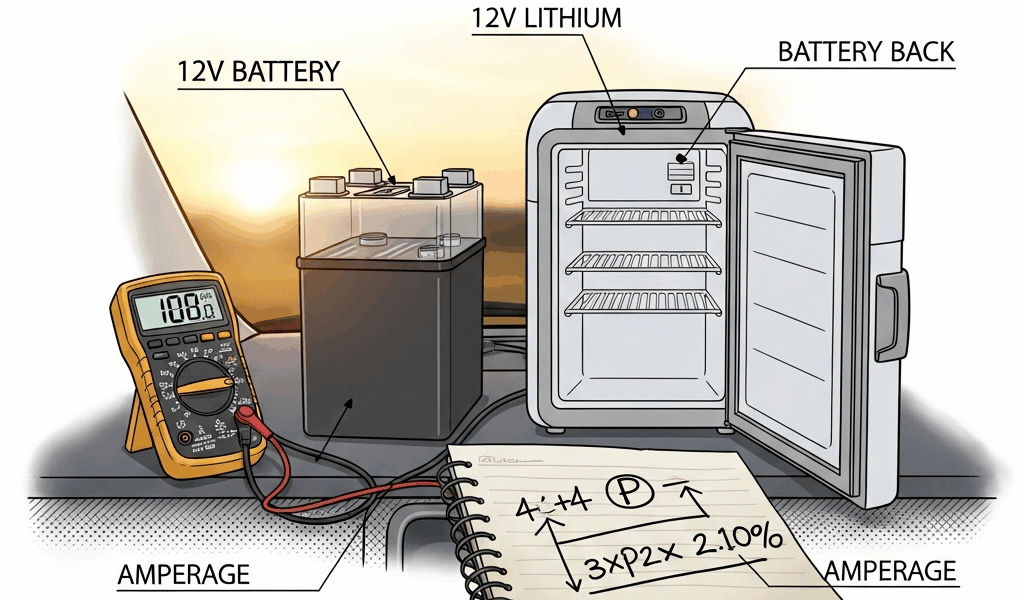
Here’s the actual situation. Compressor fridges draw somewhere between 3 and 7 amps — continuously — depending on ambient temperature, how frequently you’re raiding the lid, and how aggressively the unit is chasing your setpoint. Run that math across a full overnight: 10 hours of sleep equals 30 to 70 amp-hours gone. Wire that fridge to an undersized bank with no isolation from your starter battery, and you’ll wake up to silence when you try to crank the engine. It’s not mysterious. Fridge amperage multiplied by hours running equals total draw. Total draw beats available capacity. Battery dies.
Most overlanders don’t catch the pattern until night four — three days of perfectly cold drinks, then suddenly the voltage sags and nothing works. That’s not a fridge failure. That’s a math problem wearing a fridge costume.
Step 1 — Calculate Your Actual Overnight Draw
Probably should have opened with this section, honestly. This math alone solves it for half the people who ask the question.
Pull the actual amp draw from your fridge manual — or measure it yourself with a cheap inline ammeter. I’m apparently an impulse buyer and the AiLi 100A unit works for me while eyeballing specs never does. Twelve bucks on Amazon. Don’t guess.
Most 40- to 50-liter compressor fridges average 3 to 5 amps in moderate conditions. But “average” is doing heavy lifting in that sentence. Push ambient temps to 95°F with the fridge sitting in afternoon sun, and that number climbs to 6 or 8 amps. Open the lid every thirty minutes? Add another amp or two of cycling overhead. Easily.
Now do the math yourself:
- 5A average draw × 10 hours overnight = 50 amp-hours consumed
- 6A average draw × 10 hours in heat = 60 amp-hours consumed
- 8A spike draw × 10 hours with frequent access = 80 amp-hours consumed
Running a 100Ah lithium auxiliary? You should only discharge to roughly 80% depth before the BMS cuts things off. That’s 80 usable amp-hours. A 60Ah lead-acid? You’re down to maybe 30 usable amp-hours — if you want the thing to survive past two seasons. Compare that to your consumption numbers. The problem usually jumps off the page immediately.
If your overnight fridge draw plus lights, cooking, and anything else exceeds usable capacity, the battery dies. Period. Everything else is just diagnosis.
Step 2 — Check Whether Your Fridge Is on the Right Circuit
Wiring architecture matters as much as raw numbers. I’ve seen brand-new overlanders run a positive and negative cable straight from the engine bay to a 12V fridge — no isolator, no DC-DC charger, just a breaker between them and disaster. Don’t make my mistake. I did exactly this on my first build and it cost me two starter batteries inside eighteen months.
That setup does two genuinely terrible things. First, it lets the fridge drain the starting battery below safe voltage — somewhere around 12.4 volts, a lead-acid starter battery begins sulfating and permanently loses cranking amps. Second, the fridge never recharges unless the alternator is spinning, which it isn’t while you’re sleeping.
But what is a battery isolator? In essence, it’s a device that separates your starter and auxiliary circuits automatically. But it’s much more than that — it’s the difference between a truck that starts and one that doesn’t. A basic unit runs about $40 to $80 and cuts the fridge off from the starter battery when voltage drops below a set threshold. A DC-DC charger — roughly $200 to $500 depending on amperage — does the same job but also regulates alternator charging and protects both batteries simultaneously. The Redarc BCDC1225D is what I run. About $310. Worth every cent.
Check your fridge’s low-voltage cutoff too. Many stock settings sit at 10.5 or 11 volts. That’s dangerously low — you’ll damage the battery regularly at those thresholds. Raise it to 12.2 or 12.4 volts if the unit allows adjustment. The fridge will shut down more aggressively, but the battery will last years longer. Simple trade.
Step 3 — Diagnose Compressor and Seal Issues
Battery is right-sized. Fridge is on an auxiliary circuit. Still waking up to a dead battery. The fridge itself might be working way harder than it should — not broken, just compromised.
Run the paper slip test on the door seal first. Shut the door on a standard piece of printer paper and pull. No resistance? The seal is shot. A failing gasket lets warm air leak in constantly, forcing the compressor into overdrive. A fridge that normally averages 5 amps can quietly become a 7 or 8 amp unit with a bad seal. That’s 20 to 30 extra amp-hours overnight.
Airflow is another overlooked issue. Compressor fridges need clear space above and behind the unit to vent heat. I once packed a Dometic CFX3 55 into a storage cabinet with roughly two inches of rear clearance. The compressor was drawing about 40% more power than spec because it simply couldn’t dump heat. Moved it forward by four inches and the draw dropped immediately.
Temperature setting matters more than most people realize. Running at minus 2°C to keep meat frozen? In 35-degree camp heat, the compressor runs almost continuously. Dial back to 2 or 3°C — food stays cold, the compressor cycles less, and your amp-hours stretch noticeably further into the night.
Finally, sun exposure. A fridge sitting in direct afternoon sun absorbs significant radiant heat even with venting. Move it into shade if the site allows, or drape a light-colored tarp over the top and sides during peak hours. Small effort. Meaningful impact on draw.
What to Do If Your Setup Is Undersized
Honest assessment time. Running a single 100Ah AGM battery and a 50L fridge with no active charging source? The system is undersized. That’s not a buried insight — that’s a straightforward fact to act on.
Three realistic upgrade paths exist, and that’s what makes this situation manageable to us overlanders who’d rather spend money once than twice:
- Add a second battery. A second 100Ah lithium unit — roughly $800 to $1,200 depending on brand — doubles your usable capacity. Suddenly 80 amp-hours of overnight draw is manageable. Lithium costs more upfront but weighs less than AGM, holds charge better in cold, and realistically lasts ten-plus years.
- Add solar charging. A 100W panel ($150 to $300) paired with a basic MPPT controller ($80 to $150) recovers somewhere between 300 and 500 amp-hours weekly depending on sun exposure. You won’t fully recharge a depleted battery by noon — but you’ll meaningfully slow the drain and buy time between drive days.
- Add alternator charging. A 60A DC-DC charger ($250 to $400) keeps the auxiliary bank topped up during driving. Road days become full recharges, so you always start camp with a full tank regardless of how brutal the previous night was.
Most overlanders land on a combination — second battery plus a 100W solar panel. Total cost lands around $1,200 to $1,500. That setup handles a 50L fridge indefinitely in hot conditions, assuming you’re not simultaneously running a massive inverter or electric cooktop.
So, without further ado, let’s make this simple: do the overnight draw math first. Your amp-hours consumed must be less than your usable capacity. If the numbers don’t line up, upgrade the energy system — not the fridge.


Stay in the loop
Get the latest trail owl updates delivered to your inbox.