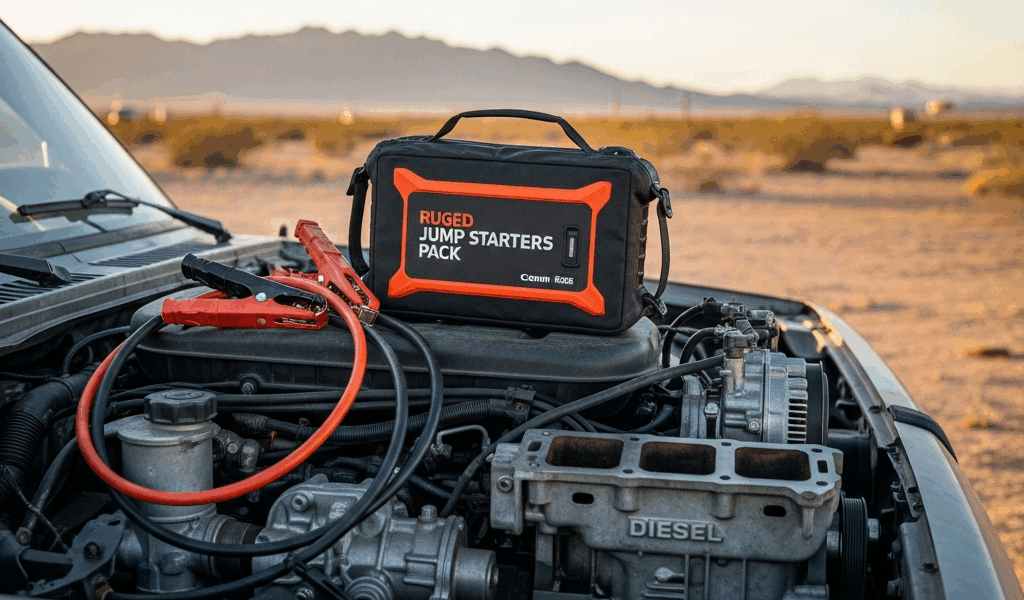
Overlanding Jump Starters Have Gotten Complicated With All the Spec Sheet Noise Flying Around
As someone who got stranded outside Moab at 2 AM in 18-degree weather watching a consumer-grade jump starter die in real time, I learned everything there is to know about overlanding power. Today, I will share it all with you.
The situation goes like this. You’ve parked your rig for three days running a fridge, LED lights, and a ham radio. Overnight, temperatures crater. Your diesel or large V8 — already stubborn in cold weather — now wants 50 percent more cranking current than it did in July. Your jump starter, meanwhile, has been sitting in that same frozen truck bed doing absolutely nothing useful. Most portable units rated at 1,000 peak amps at 70°F drop to roughly 600 amps at 20°F. Peak amps, by the way, are almost entirely a marketing fiction.
Probably should have opened with this section, honestly. Overlanders operate 30 miles from pavement with no AAA card and exactly zero second chances. A spec sheet number means nothing when your lithium battery has thermally throttled itself into a very expensive paperweight.
Generic reviews push whatever’s cheapest or prettiest without acknowledging any of this. They skip over the fact that diesel engines need 150–200 amps of sustained cranking current just to turn over — that you might need three or four attempts before the engine catches — and that sitting in extreme cold or heat for months degrades performance in ways manufacturers never actually test for.
What Actually Matters in a Jump Starter Spec Sheet
But what is a cranking amp, really? In essence, it’s the sustained output your starter delivers over roughly 30 seconds under real load. But it’s much more than that — it’s the number that actually determines whether your engine starts or whether you’re building a fire and waiting for sunrise.
Peak amps is a different animal entirely. That’s the maximum output for about five seconds under perfect lab conditions. If the spec sheet only lists peak amps and buries everything else, move on. Seriously.
Battery capacity comes next. Watt-hours — Wh on the label — tells you total stored energy. A 400 Wh unit handles multiple start attempts before needing a recharge. Something under 200 Wh might quit after one try, especially when cold air is pulling harder on the battery and the unit itself is running at reduced efficiency. For overlanding, 300 Wh is the floor. Four hundred or above is where you want to land.
Operating temperature range is non-negotiable — at least if you venture anywhere with actual winters. Lithium batteries perform badly below freezing. Check whether the manufacturer lists charging temperature (usually 32–104°F) separately from operating temperature. Some units have built-in battery warming circuits. Others absolutely don’t. That distinction matters more than the color of the carrying case.
USB-C passthrough charging is a genuine bonus. Charge your phone, laptop, or GPS unit directly from the jump starter while it sits in your vehicle. Not essential, but genuinely useful on multi-day trips when every watt counts.
Weight and size aren’t afterthoughts either. A 50-pound jump starter is heavy enough to leave at home. Anything under 10 pounds works fine for most rigs — though the smallest units sacrifice capacity to get there. Find the balance between portability and actual usable power.
Best Jump Starters for Overlanding Ranked by Use Case
Noco Boost Pro GB150 — Budget Gas Rigs
The Noco Boost Pro GB150 delivers 4,000 peak amps and 1,000 cranking amps in a package smaller than a thick paperback book. Weighs 8.2 pounds. Price runs $180–220 depending on where you buy it.
I’m apparently a small-truck person and the GB150 works for me while anything heavier never quite felt right. The built-in USB-C port charges devices without drama. It ships with decent cables, a carrying case, and a two-year warranty that Noco actually honors.
Real con: 1,000 cranking amps won’t comfortably start a diesel or large-displacement V8 in cold weather. If your rig is a small four-cylinder or a light truck under 5,000 pounds, this works fine. Anything heavier, or any diesel, look elsewhere. Charge time runs 4–5 hours from a standard outlet, which is worth knowing before a trip morning.
Best for: Budget overlanders with gas engines in moderate climates. Not the right tool for winter travel below 20°F.
Antigravity Micro-Start XP-10 — Lightweight Serious Travelers
The Antigravity Micro-Start XP-10 is genuinely compact. Four pounds. About 6 inches long. Peak amps hit 400, cranking amps land around 180. Price is $300–350 — premium dollars for premium portability.
Nothing else on the market gets close to this size-to-function ratio. If weight and space matter more than raw power — overlanding on a motorcycle, for instance, or any situation where every ounce is a real conversation — this is the unit. Build quality is excellent. It handles repeated charge cycles without obvious degradation. Many overlanders carry two of these instead of one larger unit specifically for redundancy. That’s not a bad strategy.
Don’t make my mistake of expecting diesel performance from a 4-pound unit, though. At 180 cranking amps, it’s tight even for small gas engines in cold weather. For diesels, completely unsuitable. This is honestly more of a backup unit or a secondary option in a multi-vehicle expedition kit.
Best for: Weight-conscious overlanders with small gas engines, or as a backup in any overlanding setup that already has primary power covered.
Clore Automotive JNC660 — Diesel and Large Gas Engines
The Clore Automotive JNC660 sits in the gap between consumer and professional-grade equipment. 2,000 peak amps, 1,100 cranking amps. Price typically runs $400–450. That was before recent supply chain weirdness, so check current pricing.
The real advantage here is chemistry. Lead-acid maintains 85–95 percent output effectiveness down to 0°F — something no lithium unit on this list can match. The aluminum housing is robust. The clamps are heavy-duty. If you run a diesel engine or a large V8, this is practical expedition equipment rather than consumer gear dressed up in aggressive packaging.
Real con: 35 pounds. This isn’t portable in the traditional sense. You need dedicated space in your rig and a plan for where it lives. Charge time runs 8–10 hours. Lead-acid requires maintenance charging every few months during storage to prevent sulfation — skip that step and you’ll eventually own a very heavy paperweight. The unit also runs noticeably warm during operation, though that’s rarely a safety concern in practice.
Best for: Diesel overlanders and large-engine rigs where weight isn’t the primary concern. Excellent for base camp setups or larger expedition vehicles with dedicated storage.
DeWalt DXAEJ14 — Professional-Grade All-Purpose
The DeWalt DXAEJ14 is marketed as a professional jump starter. 1,400 peak amps, around 900 cranking amps, 80 Wh capacity. Price runs $250–300.
DeWalt backs these with industrial warranties. Charges fully in about 2.5 hours via USB-C — that’s the fastest full charge on this list. Operates reliably down to 32°F without significant capacity loss. The case design accommodates jumper cables cleanly rather than forcing you to improvise storage. If you’re already running DeWalt 20V MAX batteries across contractor-level tools, the cross-compatibility is a genuine convenience rather than a marketing footnote.
Real con: 900 cranking amps is marginal territory for larger diesels. This is a generalist tool that does most things competently but nothing exceptionally. Battery capacity sits lower than competitors at the same price point — 80 Wh is lean for multi-attempt starts in cold weather.
Best for: Contractors and builders overlanding with mid-size trucks and gas engines. Solid middle-ground option when you want something that pulls double duty on a worksite and a trail.
Cold Weather and Diesel Rigs — What You Have to Know
Frustrated by a lithium jump starter that lost half its output in 15-degree weather on a January trip into Colorado, I eventually figured out a workaround most overlanders never hear about. Before connecting the jump starter to your battery in freezing conditions, run the unit by itself for 30–60 seconds. Don’t connect it yet. That brief internal warm-up cycle gives the battery management system time to improve efficiency before the actual load hits. Small step. Genuinely matters.
Lithium capacity loss follows temperature pretty linearly. At 32°F, expect 50–70 percent of rated output. At 0°F, maybe 40 percent. Below certain thresholds, some units simply won’t engage at all. That’s what makes lead-acid endearing to us diesel overlanders — it maintains 85–95 percent effectiveness down to 0°F without complicated warm-up rituals.
Diesel engines require specific numbers. A standard-displacement diesel — 5.0L to 7.3L — needs minimum 1,200 cranking amps for reliable cold starts. Larger engines want 1,500 and up. Cold air compounds everything. Add 50 percent to your minimum requirement when sub-20°F temperatures are realistic. A Cummins or Duramax in January needs 1,800 amps of sustained output. Not 1,200. Not “approximately 1,200.” Eighteen hundred.
So, without further ado, here’s the winter strategy. First, invest in a second jump starter or carry a quality lithium battery bank paired with a dedicated battery isolator system. Second, keep your jump starter inside your sleeping bag or an insulated cooler when temperatures drop overnight — or plug it into a USB power supply during camp setup if you have shore power. Third, seriously consider the Clore JNC660 if cold is your primary operating environment. Lithium wins on weight and convenience in three-season conditions. Lead-acid wins on reliability below freezing. That’s just chemistry.
How to Store and Maintain a Jump Starter on the Trail
Charge before every trip. Not every other trip. Every single trip. A jump starter sitting discharged for months actively loses internal battery health — that’s not a maybe, it’s how lithium chemistry works. Full charge should happen at least 24 hours before departure.
Never store in direct sunlight inside your vehicle cab during summer. Closed truck cabs exceed 140°F easily on a hot afternoon. Lithium batteries degrade rapidly above 130°F. Mount it in a shaded lower cabinet, under a seat, or inside an insulated storage box — at least if you park in places where summer heat is a real factor.
During extended off-season storage, recharge every 3–6 months. Store at roughly 50 percent charge when possible. Full charge sitting for months wastes battery chemistry faster than use does. Zero charge for months encourages sulfation in lead-acid units specifically — the Clore JNC660 owners need to pay attention to this one.
Clean terminals and clamp contacts every other charging cycle. Corrosion builds faster on expedition vehicles than on street rigs — the combination of dust, mud, moisture, and temperature swings accelerates everything. A small wire brush or fine steel wool handles it in two minutes. Dirty contacts reduce power transfer efficiency by 15–20 percent, which is exactly the margin you don’t want to lose when you’re trying to start a cold diesel at 5 AM.
For your specific situation: diesel engine in cold climates, buy the Clore Automotive JNC660. The 35-pound weight penalty is worth the reliability. Standard gas overlanding, the Noco Boost Pro GB150 is practical and won’t empty your gear budget. Lightweight travel, the Antigravity Micro-Start XP-10 as a backup unit. Keep it charged, keep it out of the heat, and it’ll start your rig when nothing else is around to help.

Stay in the loop
Get the latest trail owl updates delivered to your inbox.